Got Medicare questions? You’re not alone. Whether you’re getting ready to enroll, exploring coverage options, or wondering about costs, Medicare has a lot of moving parts to figure out.
If you’re looking for a little help to make enrollment easier, check out the answers to these 18 most commonly asked Medicare questions.
1. Who qualifies for Medicare?
To qualify for Medicare, you need to be a U.S. citizen or legal resident who is 65 or older or under 65 with a qualifying disability or End Stage Renal Disease.1
You’re eligible to receive Medicare Part A at no charge if you’re 65 or older and…
- Receive retirement benefits from Social Security or the Railroad Retirement Board.
- Are eligible for those benefits but haven't filed for them yet.
- Had Medicare-covered, government employment.
You may also qualify before age 65 if you…
- Have received Social Security disability benefits for 24 months.
- Have ALS (Amyotrophic Lateral Sclerosis, or Lou Gehrig’s Disease).
- Have End-Stage Renal Disease and have received kidney dialysis or a kidney transplant.
Many people do not have to pay a premium for Medicare Part A (hospital insurance). However, everyone pays a premium for Medicare Part B (medical insurance).
2. Do I automatically get Medicare at 65?
If you’re 65 and already receive Social Security, you will be automatically enrolled in Original Medicare (Part A and Part B).2
If you do not receive Social Security, you will need to sign up through the Social Security Administration. You can do this online, by phone, or at your local Social Security office.
3. When can I enroll in Medicare?
You can sign up for Medicare during the seven-month Initial Enrollment Period, which includes the three months before your 65th birthday month, your birthday month, and the three months after.2
If you do not sign up during your Initial Enrollment Period, you may have to wait until the General Enrollment Period, which runs from January 1 to March 31 each year. Special Enrollment Periods are available in certain situations, such as losing employer group coverage.
4. What happens if I don’t sign up for Medicare at 65?
If you do not have creditable coverage and delay enrollment, you may face late penalties:3
- Part B penalty: Monthly premium increases by 10% for each 12-month period you delay. This usually lasts as long as you have Part B.
- Part D penalty: You'll pay an extra 1% of the national average premium for each month you delay. This penalty lasts as long as you have Medicare drug coverage.
5. Do I need Medicare if I have group health coverage?
It depends on the size of your employer:4
- Fewer than 20 employees: You should enroll in Medicare when you're eligible. Medicare pays your claims first, and your group plan pays second.
- 20 or more employees: You can usually keep your group coverage and delay Medicare enrollment without penalty.
You can still sign up for premium-free Part A even if you have group coverage. One plan pays first, the other pays second. Compare your group plan with Medicare options to see which offers the best value.
6. Can I work full time while on Medicare?
Yes. You can work full time and have both employer coverage and Medicare Part A.5 When you retire or lose group coverage, you can enroll in Part B and then add Medicare Advantage or Medigap plan if you'd like.
7. Do I have to sign up for Medicare if I have private insurance?
You’re not required to enroll, but you may face penalties if you delay.
If you have an Affordable Care Act (ACA) plan, you'll lose eligibility for ACA subsidies once you're eligible for premium-free Medicare Part A.6
8. What does Medicare cover?
Original Medicare includes:7
- Part A (Hospital Insurance): Inpatient care, skilled nursing facility care, hospice, some home health care.
- Part B (Medical Insurance): Doctor visits, outpatient care, preventive services, lab tests, medical supplies.
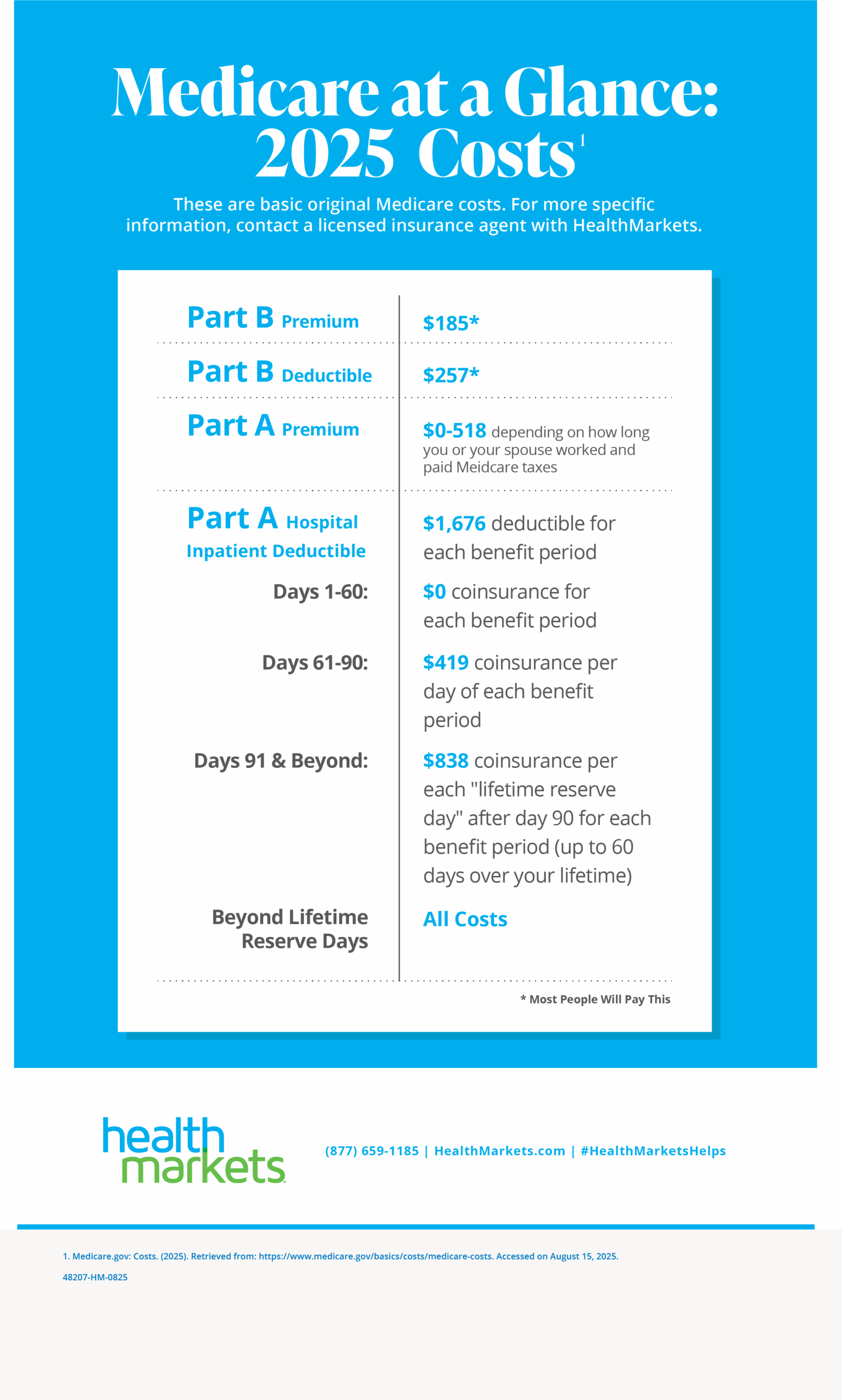
9. How much does Medicare cost?
The cost depends on your coverage:
- Part A: Most people do not pay a monthly premium for Part A.
- Part B: The standard monthly premium for Part B in 2026 is $202.90, and the annual Part B deductible is $283.8
- Part D: In 2026, the average monthly premium for a stand-alone Part D plan is $34.50.9
- Other coverage: Medicare Advantage and Medigap plans have additional costs that vary by plan. You may also have deductibles, copayments, or coinsurance.
10. Does Medicare cover prescription drugs?
Original Medicare does not cover most prescription drugs you buy at a pharmacy.
However, you can add Part D prescription drug coverage or choose a Medicare Advantage plan that includes it. In 2026, the average monthly premium for a stand-alone Part D plan is $34.50, although costs can vary by plan and location.9
Ther's also good news for anyone worried about high drug costs: In 2026, your out-of-pocket costs for covered prescription drugs are capped at $2,100 per year. Once you reach that limit, you pay nothing for covered drugs for the rest of the year.9
11. Is there an alternative to Original Medicare?
Yes. Medicare Advantage (Part C) is offered by private insurers and combines Parts A and B, and may include additional benefits.10
12. Does Medicare cover everything?
No. Original Medicare has out-of-pocket costs such as deductibles, copayments, and coinsurance. Medigap plans can help cover some of these costs.
13. What is Medicare Part A?
Part A is hospital insurance that covers inpatient care, skilled nursing facility care, hospice care, and some home health services.11
14. What is Medicare Part B?
Part B is medical insurance that covers medically necessary and preventive services, including doctor visits, lab tests, and outpatient care.12
15. What is Medicare Part C?
Also called Medicare Advantage, Part C is offered by private insurers and combines Parts A and B in one plan, and may include additional benefits.10
16. What is Medicare Part D?
Part D is prescription drug coverage offered by private insurers. It works with Original Medicare unless your Medicare Advantage plan already includes drug coverage.13
17. What is Medigap?
Medigap, or Medicare Supplement Insurance, is sold by private insurers to help pay some costs not covered by Parts A and B, such as copayments, coinsurance, and deductibles.14
18. Who can answer my Medicare questions?
Got more Medicare questions? If you or someone you know is eligible for Medicare and wants to learn more, we can help. Just give us a call at (855) 779-8142 to speak with a licensed health insurance agent or find a licensed health insurance agent in your area.